


 7015
7015 0
0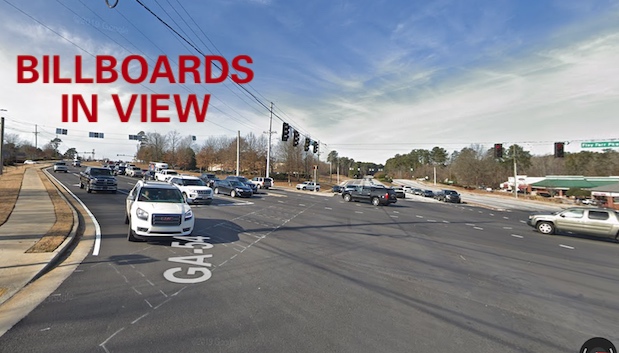
City’s sign rules, zoning ordinances to be challenged in coming court case —
Peachtree City is known for at least two things: miles of cart paths and no billboards — not ever a billboard, not even one.
The cart paths remain, but the billboard desert may change if a Macon-based billboard company wins a coming court case against the Peachtree City Council.
None will change to three — big, 10-foot by 36-foot, LED-bright billboards, two of them within yards of the busiest traffic spot in Peachtree City, towering above the bridge across the CSX railroad tracks that bisect the city’s largest commercial center.
If the city loses, drivers heading east and west on Ga. Highway 54 will be seeing the Super-Bowl-sized screens flashing rotating commercial messages just beyond The Avenue and just before the Walmart-Home Depot shopping area.
The signs will be the first billboards that have ever been erected inside the city with its signature sign ordinance so strict that it once prohibited soft drink vending machines outside businesses and lighted “Open” and “Closed” signs above bank drive-thru lanes.
For the council, that’s the nightmare outcome of what started as two city mistakes, one of them from the early 2000s and the other from last October. But first, here’s what happened Thursday night as the prelude to the first legal challenge to the city’s sign ordinance in many years.
There was little clue in the City Council agenda for Feb. 18 that a coming struggle might jeopardize the foundation of the city’s unique qualities — its zoning ordinance.
In fact, The Citizen story about the upcoming meeting labeled it as a “sign dispute.” That may have been a billboard-sized understatement.
Principle Outdoor, LLC, a Macon-based advertising company, filed requests last fall for permits to allow billboard signs in three locations — all of them located on CSX railroad right of way. Besides the Hwy. 54 railroad bridge site, the other sign would add its glow next to the MacDuff Parkway bridge crossing the rail tracks and intersecting with Senoia Road in northwest Peachtree City.
Because the signs exceeded the city’s limits on height and width and because they would be “internally illuminated” signs and were prohibited in the sign ordinance, the city said no, as it had to similar requests for billboards in other locations over the years.
They notified the applicant via email within the required 30-day period of the denial. And thus the first known problem arose.
The city ordinance requires a sign request denial be delivered either in person or by certified mail. The company later said it never received the email. The city then sent the required certified letter, but it was after the city ordinance deadline.
That’s when the lawyers got involved.
Attorney Scott Peters, who works in the Atlanta law firm of Schreeder, Wheeler & Flint, LLP, then filed an appeal on behalf of Principle Outdoor, LLC.
And here’s where the city realizes there’s a bigger problem than the email error and the late certified mail denial.
Peters told the council Thursday night during the appeal hearing that:
(1) The railroad property from which will spring the billboards was unzoned — no city zone of any kind showed up on the city zoning map — and thus the sign ordinance based on zoning category had no legal control over the CSX property. “We are not in the zone,” Peters said.
(2) Even if the property was zoned properly, the sign ordinance “flipped the First Amendment on its head,” Peters argued, because it started from the premise that every sign in the city was illegal unless the city first gave its approval. “The entire sign ordinance is unconstitutional,” Peters said, under the legal doctrine of “prior restraint” on an otherwise constitutionally permitted form of speech.
The city couldn’t argue about the unzoned rail tracks — but the kicker is that it was not always so. City Manager Jon Rorie said the railroad property showed up as an industrial zone in all city zoning maps that have been re-adopted each year for decades until around 2000, when the CSX property inexplicably dropped off the zoning map, showing no zone at all, unlike all other property in the city. If it’s not on the zoning map, it’s not zoned.
“Nobody caught it,” Rorie said. Until an Atlanta lawyer did.
The approach was to circumvent the city’s carefully planned zoning rules and accompanying sign restrictions. The applicants worked out a deal to rent some CSX right of way to erect three tall billboards at strategic places where the rail line crossed busy thoroughfares. It doesn’t get much busier around here than the 54-74 intersection.
It’s too late for the city to rezone the CSX property and deny the signs, although the city may next month re-adopt the zoning map showing the tracks as having a zone of some kind to prevent a similar situation from arising in the future.
And officials said they are working on contingency zoning rules just in case the whole zoning edifice underpinning the development of Peachtree City is thrown out by some court.
City Attorney Ted Meeker argued that even with the email mistake, previous Georgia court cases have held that the governing body can correct a mistake in zoning, including signage.
The council heard and denied the appeal 5-to-0, but the case doesn’t end there.
The next step for the billboard company is an appeal to Fayette Superior Court, using the same arguments as Peters used Feb. 18.
Whatever the outcome, the losing side likely will take the case to the next level, the Georgia Court of Appeals. And a loss there will likely be appealed to the Georgia Supreme Court.
A win for the billboard company could be lucrative: Selling ad space on the only three billboards in one of the state’s most affluent cities, an exclusivity that likely would cost advertisers big bucks. It might be considered in the billboard world the local version of commercial spots in the Super Bowl.
A loss for the city would put previously forbidden signage in the most visible spot in the city — bright, flashing, visible for a mile in either direction, and unavoidable for thousands of drivers every day who pass over that bridge — and might tempt other sign-makers to try their luck in court.
But as City Attorney Meeker emphasized in his argument: “We all make mistakes.” The city now hopes for judges sympathetic to human — and governmental — mistakes.





Leave a Comment
You must be logged in to post a comment.